Masha and the Bear Mini Games
- 4.3
- Rating
- 50.00M
- Installs
- Free
- Price

 Analysis by App-foxy
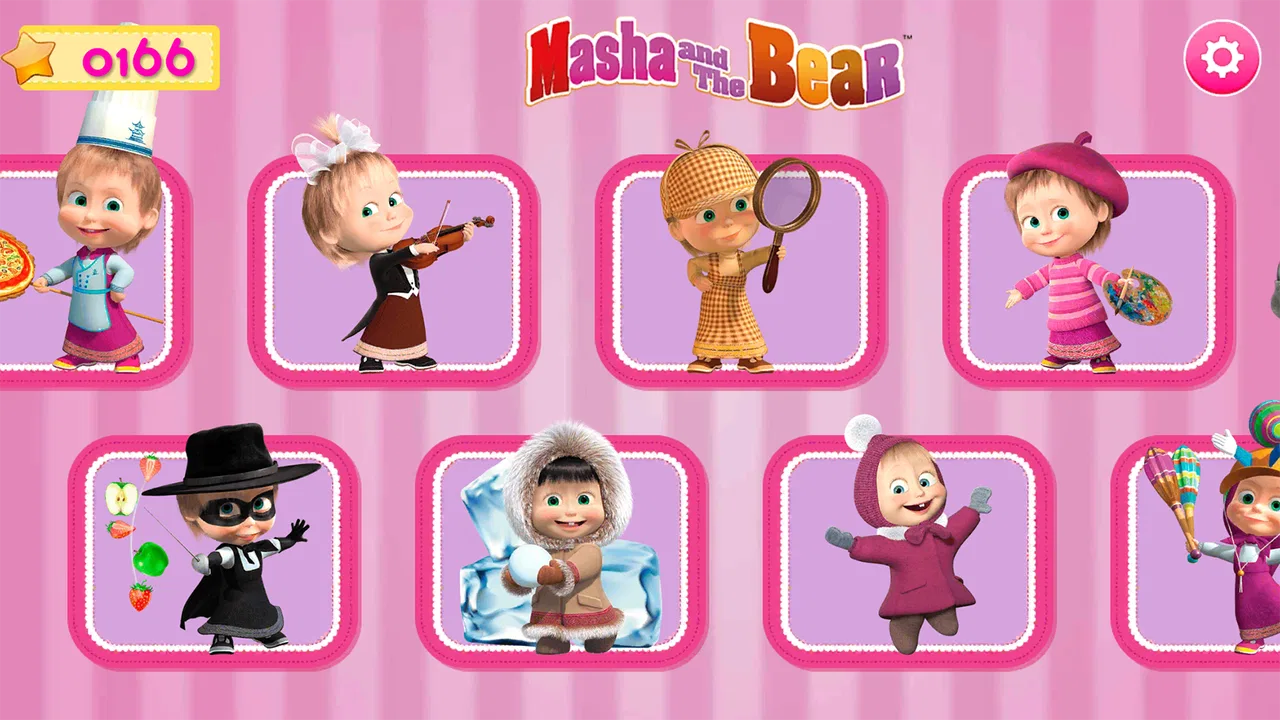
Masha and the Bear Mini Games is the kind of educational game I would put in front of a young child when I want something familiar, light, and easy to start. It comes from DTC Lab and uses the world of Masha and her friends to introduce simple profession-themed activities rather than asking children to learn through long explanations. I found that approach more inviting than a traditional lesson, especially for children who respond better to characters and short tasks than to worksheets.
The game is free to download and is rated for Everyone, so it is clearly aimed at a broad family audience. It has also reached over 50 million installs and holds a 4.3 average from around 69 thousand ratings, which suggests that it has become a well-known choice among families looking for Masha-themed play. Those figures do not replace personal judgement, but they do make it easier to see why this particular game remains visible among children’s educational apps.
How the mini-game format works for young learners
The central idea is simple: children learn about different professions while playing with recognizable characters. That matters because the lesson is wrapped in an activity instead of being presented as a formal quiz. In my experience, a child is more likely to keep trying when the task feels like part of Masha’s world rather than a test that demands a correct answer immediately.
You May Also Like

 AccuWeather: Weather Radar
AccuWeather Review: A Quick, Clear Forecast for Everyday Decisions
For everyday plans, the best forecast is the one you can understand quickly. AccuWeather makes rain timing, radar, and local conditions easy to act on, with a few trade-offs.

 Hill Climb Racing
Why Hill Climb Racing Still Turns Crashes Into One More Run
A tiny car, a bumpy hill and one more upgrade: Hill Climb Racing keeps resurfacing because its simple chaos makes every near-miss feel personal.

 AliExpress - Shopping App
AliExpress Makes Global Shopping Feel Personal, but Shoppers Bear the Risk
AliExpress turns a global marketplace into a pocket-sized discovery engine. Its reach is useful, its shopping loop compelling, and its trade-offs easy to miss.

 Lords Mobile: Kingdom Wars
Lords Mobile Is a Kingdom-Building Routine, Not a Quick Match
A case-by-case verdict on the building, battles, device demands, and social commitments that make Lords Mobile rewarding for some players and exhausting for others.

 PDF Scanner app - TapScanner
TapScanner Makes Paperwork Easier to Capture, Check, and Share
TapScanner makes scanning with a phone feel less like a rescue operation and more like a dependable step in getting work done. Its capture tools are useful, though not flawless.

 Block Blast!
 Shows How Much a Puzzle Game Can Leave Out
A quiet grid game shows why puzzle players increasingly value instant clarity, repeatable skill and low-pressure play—and where the genre still needs to catch up.
More From Our News Desk
View All News


The short-activity structure is also useful for everyday family routines. A parent can offer it during a brief wait, after school, or as a calm activity before dinner without committing to a long session. I would not treat it as a complete early-learning curriculum, but it works well as a small, approachable introduction to ideas about work, roles, and familiar community jobs.
One practical strength is the low barrier to entry. The store identifies it simply as “Masha and the Bear,” and the recognizable theme does much of the explaining before a child even begins. Younger players often need less encouragement when they already know the characters. That can make the first few minutes smoother than with an unfamiliar educational game whose instructions and visual style require extra explanation.
Parents should still expect to guide the first session. Children may understand the playful parts quickly but need help connecting an activity with the profession it represents. I found that asking a short question afterward—such as what the character was doing or why that job might be useful—can turn a few minutes of play into a better learning moment. The game supplies the setting; the conversation supplies much of the deeper understanding.
Why the characters matter more than the lesson label
For a child who already enjoys Masha and the Bear, the familiar cast is not just decoration. It can reduce resistance to trying a new activity and give the child an emotional reason to continue. That is especially helpful for preschool-age players who may not yet choose an educational game because it promises learning. They choose it because Masha is there, then absorb the idea through play.
There is a trade-off, though. A strong character theme can make the experience feel more like entertainment than structured learning. If your priority is letter formation, arithmetic practice, reading fluency, or a carefully staged school syllabus, this is not the tool I would choose first. Its value is in accessible discovery and playful recognition of professions, not in replacing a dedicated literacy or numeracy app.
I also think the theme makes it better suited to shared use than to completely independent learning at the beginning. A parent can name the profession, relate it to people the child has seen, and encourage the child to explain what happened. That small amount of participation helps prevent the game from becoming a sequence of taps with no lasting connection to real life.
What a useful play session looks like at home
Imagine a child waiting while a parent finishes preparing dinner. Instead of opening a general video app, the parent starts one of the mini-games and lets the child explore for a short while. When the activity ends, the parent asks the child to describe the job shown and whether anyone in the neighborhood does something similar. That turns a convenient distraction into a quick conversation about community life.
Another good routine is to choose one profession at a time and revisit it outside the game. A child might draw the tools associated with that job, pretend to perform it with toys, or notice examples during a walk. This is a non-obvious advantage of the concept: professions provide natural bridges from screen play to imaginative play. The game does not need to carry the entire educational burden if adults use its themes as prompts.
I would keep sessions flexible rather than promising a fixed daily program. Some children will want to repeat a favorite activity, while others will move quickly between choices. Repetition can be useful when it encourages recognition, but it becomes less valuable when the child is only tapping through familiar actions without talking about what they mean. Watching the child’s engagement is more useful than enforcing a rigid schedule.
Spending, progress, and whether the experience feels fair
The game is free, but it includes in-app purchases ranging from $1.99 to $64.99 per item. That is the most important spending detail for parents to understand before handing over a device. A free download does not mean every possible part of the experience has the same cost, so I would check the purchase controls on the device and make sure a child cannot approve transactions casually.
I appreciate that the purchase range can be stated plainly without pretending to know more than is available. The listed prices establish that optional spending exists and that individual items can vary considerably in cost. They do not, by themselves, tell me which activities are included, how often a child encounters a purchase prompt, or whether paid content changes the educational value. I would not assume either a generous free package or an aggressive sales design without seeing the exact in-game flow on the device being used.
That uncertainty affects my recommendation. For a supervised child, the free starting point may be enough to decide whether the style suits the family. For an unsupervised child with access to a payment method, I would not install it and simply walk away. The safest workflow is to set purchase approval first, explain that buttons can lead to real spending, and let the child play within a clear boundary.
The game’s current version is 18.6, and it runs on devices using Android 8.0 or later. Those details are useful when deciding whether an older family phone or tablet can handle the installation. They also suggest that compatibility should be checked before planning a trip or a long offline activity around it. A game can be a good fit in principle and still be inconvenient if the available device does not meet the operating-system requirement.
Progress without pressure
Mini-games can make progress feel approachable because each task has a small scope. A child does not have to understand a large system before beginning. That is a good match for short attention spans, and it can make success feel immediate. I especially like this format for children who become discouraged by educational apps that present a long chain of lessons before offering any sense of accomplishment.
At the same time, parents should watch for a different kind of pressure: the desire to unlock or access everything. When a child sees content that appears unavailable, the educational purpose can become secondary to obtaining the next item. Because paid content and the exact progression structure are not fully described here, I would judge the experience by the child’s behavior. If the child remains interested in the profession theme, the game is doing useful work. If the focus shifts entirely to opening locked material, it may be time to stop or switch activities.
A practical tip is to let the child finish a small activity before discussing anything paid. That keeps the first impression focused on play and learning rather than on the purchase path. I would also avoid presenting paid access as a reward for good behavior, because that can make spending seem like the natural measure of progress. A drawing, a pretend-play activity, or choosing the next profession together is a healthier follow-up.
Competitive fairness is not the main concern here
This is not the kind of game I would evaluate through leaderboards, ranked matches, or player-versus-player balance. Its purpose is educational and character-driven, not competitive. That is a positive for families who want to avoid comparison with other children. A child can explore professions without being told that another player is faster, more skilled, or further ahead.
The more relevant fairness question is whether spending creates an uneven experience between children who can buy content and children who cannot. Since the available purchase information does not describe the exact division between free and paid activities, I would avoid claiming that the game is fully fair or unfair in that respect. My judgement is narrower: the absence of competitive ranking reduces one kind of pressure, while optional purchases mean parents still need to manage expectations.
For a classroom or playgroup, I would be cautious about presenting paid access as part of the activity. The game could work as an individual, supervised resource, but equal access matters when several children are using devices together. If one child can open more content because a purchase was made, the social experience may become less about professions and more about who has access to what.
Who should choose it, and who should look elsewhere
I would recommend it most readily to families with young Masha and the Bear fans who enjoy short, guided activities and are beginning to notice different jobs in the world around them. It is also a sensible option for parents who want a free starting point before committing to a paid educational product. The character-led presentation can be especially useful when a child refuses anything that looks too much like schoolwork.
I would be less enthusiastic for an older child seeking complex problem-solving, a child who needs substantial reading practice, or a family searching for measurable curriculum progress. The profession theme is approachable, but it should not be confused with a complete program for academic skills. In those cases, a focused literacy, mathematics, or logic app would probably offer clearer progression and more direct practice.
It may also be the wrong choice for households that want a completely purchase-free environment. The game costs nothing to download, but the presence of in-app items means parents must be comfortable managing that possibility. If setting up purchase restrictions feels like too much work, a paid app with a clearly defined one-time cost may be a better fit, even if it offers fewer familiar characters.
Compared with watching ordinary Masha and the Bear videos, this game gives the child something to do rather than only something to watch. That makes it more active and potentially more educational, particularly when an adult talks through the profession being shown. Compared with a general children’s game, it has a clearer learning theme. Compared with a dedicated school-skills app, however, it is likely to feel less systematic and less useful for tracking a specific academic goal.
That middle position is where it makes the most sense. I would not choose it as the only educational app on a tablet, but I would happily use it as a themed supplement. It can open a conversation about jobs, encourage pretend play, and provide a short activity when a child needs something gentler than a formal lesson.
Small habits that improve the experience
First, play alongside the child once rather than relying on the character theme to explain everything. Notice which actions the child understands and which ones become random tapping. That tells you whether the game is teaching recognition or merely holding attention.
Second, connect the profession to something concrete. If the activity involves a role the child has encountered, mention the person who performs it and what that person helps with. This makes the game’s idea more memorable than simply repeating the name of a job.
Third, use the game as a starting point for pretend play. After a session, let the child act out the profession with household objects, draw a scene, or explain the job to another family member. This is where the app can become more than a screen-based diversion.
Finally, decide your spending rule before installation. Since purchases can range from a small amount to a much larger individual item, I would not wait for a child to ask before setting limits. A clear rule also makes the experience calmer: the child knows that playing and buying are separate decisions.
My trust verdict after weighing the trade-offs
My overall view is positive but deliberately limited. DTC Lab has built a friendly educational game around a theme that many young children already recognize, and the mini-game approach makes professions approachable without turning the experience into a lecture. The free entry, Everyone age rating, and broad device compatibility from Android 8.0 onward make it easy for many families to try.
I would trust it as a supervised supplement, not as a complete learning plan and not as a device activity that children should manage entirely on their own. The main point requiring parental attention is spending: the game is free to start, but in-app purchases are available, with listed items from $1.99 to $64.99. That is enough reason to review device controls and explain boundaries before play begins.
The game’s strongest use is a short, shared session that leads into conversation or pretend play. Its weakest use is as a substitute for structured reading, mathematics, or developmental practice. If those expectations are clear, I think it earns a place on a family device, particularly for a child who loves Masha and the Bear and needs encouragement to try educational activities.
In the end, I would recommend giving it a cautious try rather than promising that it will suit every child. Let the child explore the free starting experience, watch whether the profession theme holds attention, and judge the value by what happens after the screen is put down. Its best outcome is not simply a completed mini-game, but a child who starts asking questions about the people and jobs represented in it.
FAQs for Masha and the Bear Mini Games
01What age group is Masha and the Bear Mini Games suitable for?
Masha and the Bear Mini Games is designed for children aged 3 to 8 years old. The games are simple, colorful, and engaging, making them ideal for young kids. The app focuses on educational content, helping children develop basic skills while having fun with their favorite characters.
02Does Masha and the Bear Mini Games offer in-app purchases?
Yes, Masha and the Bear Mini Games includes in-app purchases. While the app is free to download, certain features or additional content may require payment. Parents should be aware of this and may want to disable in-app purchases in their device settings to prevent accidental purchases.
03Is Masha and the Bear Mini Games safe for children to use?
The app is designed with young children in mind and is generally safe for them to use. It does not contain inappropriate content, but parents should supervise or play along with their children to ensure a safe and controlled experience, especially if the app includes advertisements or in-app purchases.
04Can Masha and the Bear Mini Games be played offline?
Masha and the Bear Mini Games can be played offline, which is convenient for parents and children who might not always have access to the internet. However, some features might require an internet connection, especially if there are updates or additional content to download.
05What types of games are included in Masha and the Bear Mini Games?
The app includes a variety of mini-games that focus on different educational aspects, such as puzzles, memory games, and basic math challenges. Each game is designed to enhance cognitive skills and provide a fun learning experience, featuring beloved characters from the Masha and the Bear series.
Pros
- Engaging mini-games for kids.
- Colorful and vibrant graphics.
- Easy controls for young players.
- Educational elements included.
- Regular updates with new games.
Cons
- In-app purchases can add up.
- Ads may interrupt gameplay.
- Limited replay value for older kids.
- Requires internet for some features.
- May drain battery quickly.

Masha and the Bear Mini Games
Gallery